Tel: +86-513-88779999
Email: [email protected]
Tel: +86-513-88779999
Email: [email protected]
AI computing, cloud services, and hyperscale data centers are changing the way electrical infrastructure is planned and built. As server densities increase, data centers are moving from conventional commercial loads toward large, continuous power consumers that can place significant demands on utility networks, substations, and facility distribution systems.
This change is increasing demand for distribution transformers for data centers that can provide reliable capacity, efficient operation, appropriate redundancy, and long-term monitoring. Transformer selection is no longer simply a matter of matching a nameplate MVA rating to today's electrical load. Engineers and project owners need to consider IT load growth, cooling requirements, UPS losses, harmonics, redundancy architecture, installation conditions, efficiency, and future expansion.
For data center developers, the transformer can also become part of the project's critical path. Capacity, configuration, testing, customization, manufacturing lead time, and delivery planning can directly affect the schedule for energization and commissioning.
As a transformer and prefabricated substation manufacturer, Dingxin Electric provides customized transformer solutions for utility, industrial, commercial, renewable energy, and data center applications.
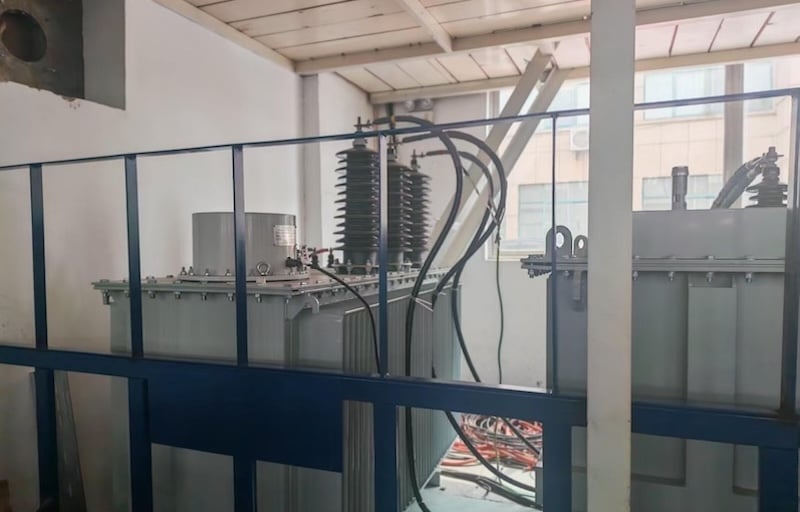
The rapid growth of AI and cloud computing is one of the major factors driving higher electrical demand in modern data centers.
Traditional data centers already require continuous power for servers, storage, networking, UPS systems, cooling equipment, lighting, security systems, and building services. AI workloads can increase the power density of individual server racks, making both the IT load and associated cooling infrastructure more demanding.
Several factors are contributing to the growth in data center electrical capacity:
AI training and inference workloads can require high-performance GPU and accelerator systems operating continuously or for extended periods. Higher computing density increases the electrical demand of individual racks and data halls.
Hyperscale operators increasingly develop large campuses with multiple data halls and phased expansion plans. Instead of designing electrical infrastructure for a single building, engineers may need to plan for substantial future capacity.
High-density computing changes the distribution profile inside the facility. Transformer capacity, UPS configuration, switchgear, busways, cooling systems, and downstream power distribution must be considered as an integrated system.
Electrical demand is not limited to IT equipment. Chillers, pumps, cooling towers, fans, air-handling systems, liquid cooling infrastructure, and other mechanical equipment can represent a significant portion of total facility power consumption.
Data center projects can range from relatively small facilities to multi-building campuses requiring tens of megawatts or more. This makes early electrical capacity planning increasingly important.
Utility Grid → Substation → Medium-Voltage Switchgear → Distribution Transformer → UPS / PDU → IT Load
A typical project may include multiple transformers and distribution paths depending on the required voltage level, redundancy architecture, physical layout, and utility connection.
A data center has a different electrical load profile from many conventional commercial buildings.
Office buildings, retail facilities, and other commercial properties may experience significant variations between working hours, weekends, and peak periods. Data centers, by comparison, are generally designed for continuous operation, with critical IT loads operating around the clock.
This difference affects transformer selection.
| Evaluation Factor | Typical Commercial Project | Data Center Project |
|---|---|---|
| Load profile | More variable, with shorter peak periods | High and relatively continuous load |
| Redundancy | Often limited | N+1, 2N, or other redundancy architectures |
| Energy efficiency | Important | Highly important because equipment operates continuously |
| Monitoring | May be optional | Often integrated into asset management |
| Expansion | Usually project-specific | Frequently planned in phases |
| Downtime impact | Project-dependent | Potentially significant for critical IT operations |
| Delivery risk | Usually manageable | Can affect overall project commissioning |
A transformer supplying a data center may operate at relatively high utilization for long periods. Thermal performance and load losses therefore become important design considerations.
Modern data centers include power electronic equipment such as UPS systems, power supplies, variable-frequency drives, and other nonlinear loads. Engineers should evaluate harmonic currents and their potential effects on transformer heating and system performance.
The appropriate transformer design depends on the complete electrical system rather than on a single equipment specification.
Transformer selection must also consider whether equipment is installed indoors, outdoors, in an electrical room, in a dedicated substation, or as part of a packaged/prefabricated solution.
Ambient temperature, ventilation, altitude, enclosure requirements, fire considerations, maintenance access, and available installation space can all affect the final configuration.
Transformer capacity planning should begin with the complete facility load rather than simply adding the rated power of the servers.
A data center electrical model may need to account for:
IT equipment load
Cooling and mechanical loads
UPS losses
Power distribution losses
Lighting and building services
Auxiliary systems
Maximum diversified demand
Future expansion
Redundant equipment
Short-term operating conditions
A simplified capacity-planning relationship can be expressed as:
Required transformer capacity ≈ Expected maximum diversified load ÷ Target loading factor
The target loading factor should not be treated as a universal value. Actual transformer sizing depends on the transformer design, cooling method, ambient conditions, loading profile, redundancy strategy, applicable standards, and project-specific engineering requirements.
One common planning challenge is the difference between the initial IT load and the final planned capacity of the data center campus.
For example, a project may initially energize only part of a planned facility while reserving space and electrical infrastructure for future data halls. In this situation, the transformer strategy may need to balance:
Initial capital cost
Transformer utilization
Available installation space
Future expansion
Redundancy requirements
Replacement or upgrade complexity
Modular transformer deployment can be considered where phased expansion is part of the project strategy.
Important: Final transformer sizing should be determined by qualified electrical engineers based on the project's load study, protection coordination, applicable electrical codes, utility requirements, and system architecture.
For critical data center infrastructure, electrical reliability is a system-level consideration.
A single-transformer configuration may not provide the required level of continuity for a mission-critical facility. Depending on the availability target and electrical architecture, data centers may use configurations such as N, N+1, 2N, or 2N+1.
N
The installed capacity is sufficient to support the required load under normal operating conditions.
N+1
One additional redundant component is provided so that the system can continue operating if one component is unavailable or fails.
2N
Two independent systems are designed to provide the required capacity, allowing one complete system to be unavailable while maintaining the required load.
2N+1
The system combines two independent capacity paths with additional redundancy.
The appropriate architecture depends on the facility's operational requirements, risk tolerance, available space, budget, utility configuration, and applicable standards.
Data center projects may consider:
Multiple transformers
Dual utility feeds
Independent medium-voltage distribution paths
Standby transformers
Separate UPS systems
Bypass arrangements
Maintenance isolation
Spare transformer strategy
Physical separation of redundant systems
Transformer redundancy should be considered together with switchgear, protection, UPS, generators, busways, and downstream distribution rather than as an isolated equipment decision.
Energy efficiency becomes increasingly important when transformers operate continuously.
Transformer losses are generally divided into no-load losses and load losses.
Core losses occur whenever a transformer is energized, even when the transformer is operating below its rated load. In a continuously energized data center, these losses can accumulate over many years.
Load losses increase with transformer loading and are primarily associated with winding resistance and other load-dependent effects.
For a high-utilization facility, engineers should therefore consider the total cost of ownership rather than evaluating a transformer solely by its initial purchase price.
Factors may include:
Purchase cost
No-load losses
Load losses
Expected loading profile
Service life
Maintenance requirements
Cooling requirements
Replacement cost
Energy costs
For applications where low lifecycle energy consumption is a priority, engineers may also compare different core materials and transformer technologies.
Related reading: [Amorphous-Core vs. CRGO Distribution Transformers]
Continuous monitoring can help data center operators understand transformer operating conditions and support planned maintenance.
Depending on the transformer type and project requirements, monitoring systems may include:
Top-oil temperature
Winding temperature
Load current
Transformer loading
Oil level
Oil pressure
Cooling-system status
Alarm conditions
Remote monitoring
Communication with BMS or SCADA systems
For oil-filled transformers, temperature and oil-related monitoring can provide useful information about operating conditions. For dry-type transformers, temperature monitoring and cooling status may be particularly important.
Monitoring does not eliminate transformer failures. Instead, it provides operating data that can help maintenance teams identify abnormal conditions, establish maintenance priorities, and respond to alarms.
For large facilities, integrating transformer information with BMS, SCADA, or an electrical asset management platform can provide a broader view of facility power infrastructure.
The monitoring configuration should be selected according to the transformer type, criticality, applicable standards, and owner's operational requirements.
Transformer procurement can become an important part of a data center project's critical path.
Large or customized transformers may require engineering review, material procurement, manufacturing, factory testing, inspection, transportation, and site installation. A late change to voltage, capacity, impedance, connection configuration, or enclosure requirements can affect the manufacturing schedule.
For this reason, transformer specifications should be developed early in the project.
Project teams should establish:
Primary voltage
Secondary voltage
Rated capacity
Frequency
Transformer type
Cooling method
Impedance
Connection group
Installation environment
Indoor or outdoor application
Efficiency requirements
Monitoring requirements
Applicable standards
Certification requirements
Required delivery date
Site and transportation restrictions
Early technical communication between the EPC contractor, electrical engineer, transformer manufacturer, and project owner can help reduce specification changes later in the procurement process.
For customized data center projects, manufacturers should also be evaluated on:
Engineering capability
Manufacturing capacity
Quality control
Factory testing capability
Customization capability
Delivery planning
Technical documentation
After-sales support
Spare parts and maintenance support
A data center transformer specification should provide enough information for the manufacturer and engineering team to evaluate the complete application.
| Specification | Information to Define |
|---|---|
| Primary voltage | Utility / medium-voltage system voltage |
| Secondary voltage | Required downstream voltage |
| Rated capacity | kVA or MVA |
| Frequency | 50 Hz / 60 Hz |
| Transformer type | Dry-type or oil-filled |
| Cooling | Applicable cooling configuration |
| Installation | Indoor / outdoor |
| Impedance | Project-specific requirement |
| Connection group | Required vector/connection configuration |
| Loading | Normal and expected maximum load |
| Redundancy | N, N+1, 2N, or other architecture |
| Harmonics | Nonlinear load considerations |
| Efficiency | Applicable efficiency requirements |
| Monitoring | Temperature, current, oil and other parameters |
| Standards | Applicable local and international standards |
| Certification | Project and market requirements |
| Delivery | Required manufacturing and delivery schedule |
This information gives a transformer manufacturer a clearer understanding of the electrical and mechanical requirements before detailed engineering begins.
The increasing power density of modern data centers means that transformer selection should be treated as part of the overall electrical infrastructure strategy.
A suitable distribution transformer manufacturer should be able to support more than standard product supply. Data center projects may require customized voltage ratios, capacities, impedance values, cooling configurations, monitoring systems, installation arrangements, and delivery schedules.
Dingxin Electric is a transformer and prefabricated substation manufacturer providing customized electrical equipment for power distribution and infrastructure projects. Our product range includes distribution transformers, power transformers, pad-mounted transformers, dry-type transformers, oil-immersed transformers, and prefabricated substations.
For projects with specific electrical, environmental, installation, or capacity requirements, Dingxin can work with project teams to develop a transformer configuration based on the actual application rather than relying solely on a standard product specification.
Data centers can use different transformer configurations depending on the utility connection, voltage levels, facility architecture, redundancy requirements, and installation conditions. Common solutions include dry-type and oil-immersed distribution transformers, medium-voltage transformers, and transformers integrated into packaged or prefabricated substations.
Transformer capacity should be based on the facility's expected maximum diversified load, including IT equipment, cooling, UPS losses, auxiliary systems, and future expansion. Redundancy and target transformer loading should also be included in the engineering analysis.
Not every facility uses the same redundancy architecture. Critical data centers may use N+1, 2N, or other configurations depending on availability requirements and the overall electrical system design.
Neither type is universally suitable for every data center. Dry-type transformers may be appropriate for certain indoor applications, while oil-filled transformers can provide advantages for particular outdoor, utility, or higher-capacity applications. The choice should consider capacity, installation environment, fire requirements, efficiency, maintenance, and project standards.
Yes. Dingxin supports customized transformer and prefabricated substation solutions based on project-specific electrical and installation requirements. Customization can cover parameters such as voltage, capacity, impedance, configuration, cooling, enclosure, monitoring, and other engineering requirements.
Data center electrical infrastructure requires careful planning of capacity, redundancy, efficiency, monitoring, customization, and delivery schedules.
If you are developing a new data center, expanding an existing facility, or planning a medium-voltage distribution system, Dingxin Electric can provide customized transformer and prefabricated substation solutions based on your project requirements.
Contact Dingxin's engineering team to discuss your transformer capacity, voltage, configuration, efficiency, monitoring, and delivery requirements.

Jiangsu Dingxin Electric, a high-tech power equipment manufacturer, produces high-quality transformers and substations, serving global markets across 30+ countries.
Room 118, Building 8, 2999 Hutai Road, Baoshan District, Shanghai, China


Copyright © Jiangsu Dingxin Electric Co., Ltd. All Rights Reserved | Privacy Policy
 EN
EN
