Tel: +86-513-88779999
Email: [email protected]
Tel: +86-513-88779999
Email: [email protected]
North America's distribution infrastructure is facing a combination of changing load patterns, new development, electrification, and increasing resilience requirements. Underground distribution systems are expanding in residential communities, commercial developments, industrial parks, EV charging projects, and other high-load applications. At the same time, data centers, distributed energy resources, and battery energy storage are creating new requirements for local distribution capacity.
A pad-mounted transformer is a key component in many of these underground distribution systems. Its enclosed, ground-mounted design provides a practical way to step down medium-voltage power for residential, commercial, industrial, and infrastructure loads without relying on overhead pole-mounted equipment.
For utilities, developers, EPC contractors, and electrical engineers, selecting the right pad-mounted distribution transformer requires more than choosing a kVA rating. Primary voltage, secondary voltage, load growth, radial or loop feed configuration, dead-front or live-front design, environmental conditions, utility requirements, and future electrification all need to be considered.
As a transformer and prefabricated substation manufacturer, Dingxin Electric provides customized transformer solutions for North American and international distribution applications.
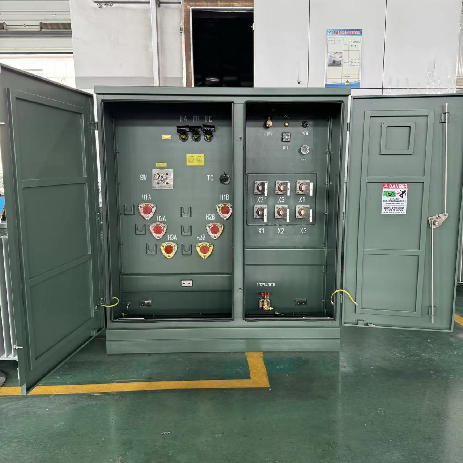
A pad-mounted transformer is a ground-mounted transformer installed on a concrete or engineered foundation and enclosed in a tamper-resistant cabinet.
It is commonly used where electrical distribution cables are installed underground. The transformer receives medium-voltage power from the distribution network and reduces it to the voltage required by downstream residential, commercial, industrial, or infrastructure loads.
Pad-mounted transformers can be configured as single-phase or three-phase transformers, depending on the application and electrical service requirements.
Typical applications include:
Residential subdivisions
Commercial buildings
Industrial facilities
Business parks
Schools and healthcare facilities
EV charging infrastructure
Renewable energy projects
Battery energy storage systems
Data center campus distribution
Utility underground distribution networks
The main difference is the installation environment and distribution architecture.
A pole-mounted transformer is installed on an overhead utility pole and is commonly associated with overhead distribution systems. A pad-mounted transformer is installed at ground level and is generally used with underground cables.
For new residential developments, commercial campuses, urban projects, and applications where overhead conductors are undesirable or impractical, pad-mounted transformers can provide a compact solution for underground electrical distribution.
The appropriate transformer type ultimately depends on the utility network, voltage class, load requirements, site conditions, and local standards.
Several infrastructure trends are increasing demand for underground distribution transformers.
Many new residential communities use underground electrical distribution to reduce overhead infrastructure and integrate electrical equipment into planned streetscapes.
As new developments expand, utilities and developers need to consider not only the initial residential load but also future demand from larger homes, EV charging, heat pumps, and other electrified equipment.
Commercial buildings, warehouses, manufacturing facilities, logistics centers, and industrial parks can require significantly more electrical capacity than conventional residential loads.
New tenants, additional production equipment, automation, HVAC systems, and electrification can increase transformer loading over time.
Data centers require continuous electrical power for IT equipment, cooling systems, UPS infrastructure, and supporting equipment.
While larger data center campuses may use dedicated substations and multiple transformers, pad-mounted transformers can also be part of site-level or peripheral distribution systems depending on the project architecture.
Related article: [Distribution Transformers for Data Centers]
EV charging is creating new localized demand across commercial properties, fleet depots, highway charging stations, and urban infrastructure.
A site that previously required relatively modest electrical service may need substantially greater capacity after the addition of multiple high-power charging stations.
This makes transformer capacity planning particularly important for EV charging projects.
Utilities across North America are also replacing aging distribution equipment while upgrading networks to support changing load patterns.
Transformer replacement programs can provide opportunities to improve capacity, safety, efficiency, environmental performance, and operational flexibility.
Hurricanes, wildfires, flooding, extreme temperatures, and other environmental events can place additional pressure on distribution infrastructure.
As utilities and infrastructure owners invest in resilience, transformer selection increasingly includes considerations such as enclosure durability, corrosion resistance, physical security, site elevation, replacement strategy, and equipment accessibility.
One of the most important questions when specifying a pad-mounted transformer is:
Should the transformer be sized for today's load or future demand?
The answer depends on the project development plan, utility requirements, load characteristics, available space, and cost of future expansion.
Simply selecting a transformer based on current connected load can create problems when electrical demand increases faster than expected.
A project team should evaluate:
Present diversified demand
Maximum demand
Continuous load
Seasonal load variations
Future building expansion
EV charging growth
Solar PV additions
Battery energy storage
New tenants or production equipment
Planned electrical service upgrades
Oversizing a transformer unnecessarily can increase initial cost and may affect efficiency at low loading. Undersizing can result in limited capacity, premature upgrades, or difficult site modifications.
The objective is to find a configuration that balances current requirements, future growth, reliability, efficiency, and lifecycle cost.
Before selecting a transformer rating, project teams should ask:
What is the present diversified electrical demand?
What load growth is expected over the next 3–10 years?
Is the load continuous, seasonal, or highly variable?
Is transformer redundancy required?
What primary and secondary voltages apply?
Will EV charging be added later?
Could solar PV or BESS be installed in the future?
Are additional buildings or tenants planned?
What utility standards govern the installation?
Is there sufficient space for future transformer replacement or expansion?
Transformer capacity should ultimately be determined through an appropriate electrical load study and engineering review.
Pad-mounted transformers can be configured for different distribution arrangements. Two common concepts are radial feed and loop feed.
| Feature | Radial Feed | Loop Feed |
|---|---|---|
| Supply path | Typically one primary supply path | Can connect to a looped distribution system |
| System complexity | Relatively simple | More complex |
| Isolation | More dependent on upstream configuration | Can provide greater operational flexibility |
| Typical application | Simpler distribution branches | Commercial, campus, and higher-continuity applications |
| Configuration | Straightforward | Designed for integration with loop systems |
In a radial distribution system, a transformer generally receives power through a single primary supply path.
The configuration can be suitable for straightforward distribution applications where the required level of supply continuity can be achieved with a single feeder arrangement.
A loop-feed configuration allows the transformer to be integrated into a looped medium-voltage distribution network.
Depending on the system architecture, switching and isolation arrangements can provide greater flexibility for maintenance and feeder management.
Loop-feed equipment can therefore be considered for commercial developments, campuses, and other applications where distribution flexibility and continuity are important.
The actual configuration must comply with the local utility's network design, switching philosophy, protection requirements, and equipment specifications.
Another important specification for a North American pad-mounted distribution transformer is whether the transformer uses a dead-front or live-front configuration.
A dead-front transformer typically uses shielded and insulated separable connectors for medium-voltage connections. The design reduces exposure to energized primary connection points during normal operation.
Dead-front configurations are widely associated with modern underground distribution systems and can be specified according to the requirements of the utility and installation.
A live-front transformer uses a configuration in which certain primary connection components may be exposed or accessible when the equipment is opened.
Live-front equipment remains relevant in some existing distribution networks and specific applications, although project requirements vary by utility, voltage level, safety requirements, and applicable standards.
There is no universal answer.
The selection should consider:
Utility standards
Primary system voltage
Maintenance procedures
Site safety requirements
Switching configuration
Existing network architecture
Applicable electrical standards
Project-specific specifications
For North American projects, the transformer manufacturer should confirm the proposed configuration against the utility's current requirements before production.
Grid resilience is becoming an increasingly important consideration for distribution infrastructure.
A transformer installed outdoors must operate within the environmental conditions of its location while remaining accessible for inspection and maintenance.
Coastal environments, industrial areas, road salt, humidity, and other factors can accelerate corrosion.
Depending on the site, engineers may need to consider:
Cabinet coating systems
Corrosion-resistant materials
Stainless steel components where appropriate
Sealing and weather protection
Environmental exposure classification
Flood-prone locations require careful consideration of:
Finished grade
Foundation design
Site drainage
Equipment elevation
Cable entry arrangements
Local flood requirements
The transformer should be incorporated into the overall site flood-resilience strategy rather than treated as an isolated piece of equipment.
Areas exposed to wildfire risk or high ambient temperatures may require additional consideration of equipment location, vegetation clearance, enclosure requirements, fluid selection, loading conditions, and local utility requirements.
Transformer thermal performance should also be evaluated based on the expected ambient environment and load profile.
Because pad-mounted transformers are installed at ground level, the enclosure and access system should address unauthorized access and accidental contact.
Depending on the project, requirements may include:
Lockable cabinet doors
Tamper-resistant hardware
Appropriate warning labels
Controlled access
Robust enclosure construction
The specific security configuration should follow utility and local safety requirements.
Modern distribution networks are becoming increasingly bidirectional and dynamic.
A pad-mounted transformer that originally supplied conventional building loads may later be affected by:
EV charging
Rooftop solar
Battery energy storage systems
Microgrids
Distributed generation
Electrified heating
New industrial loads
High-power EV chargers can create substantial local demand, particularly when multiple chargers operate simultaneously.
Engineers should evaluate:
Charger power
Number of charging ports
Simultaneous charging
Demand management
Future charger expansion
Transformer loading
Voltage drop
Secondary distribution capacity
Solar PV and BESS can change the direction and characteristics of power flow.
Depending on the system design, engineers may need to evaluate:
Reverse power flow
Voltage regulation
Protection coordination
Transformer thermal loading
Interconnection requirements
Power quality
A transformer designed for conventional one-way power distribution should not automatically be assumed to be suitable for every bidirectional application.
Related article: [Distribution Transformers for Solar, BESS, and Bidirectional Power Flow]
Before requesting a quotation from a pad-mounted transformer manufacturer, project teams should prepare as much technical information as possible.
Single-phase or three-phase
Rated kVA
Primary voltage
Secondary voltage
Frequency
Basic insulation level (BIL)
Impedance
Taps
Voltage regulation requirements
Connection configuration
Short-circuit requirements
Radial feed or loop feed
Dead-front or live-front
Primary connector requirements
Switching requirements
Fuse configuration
Surge protection requirements
Oil-filled or dry-type
Mineral oil or ester fluid where applicable
Copper or aluminum windings
Core material
Cooling requirements
Enclosure configuration
Indoor or outdoor
Ambient temperature
Altitude
Corrosion exposure
Flood risk
Wildfire risk
Physical security requirements
Installation space
Cable entry requirements
Applicable utility specifications
Local electrical codes
Required certifications
Testing requirements
Documentation requirements
Providing these details at the quotation stage helps the manufacturer determine the appropriate transformer configuration and identify potential specification issues before production.
Selecting a pad-mounted transformer manufacturer involves more than comparing equipment prices.
For a customized North American distribution project, buyers should evaluate the manufacturer's ability to support:
Transformer engineering
Custom voltage and kVA configurations
Single-phase and three-phase solutions
Radial-feed and loop-feed designs
Dead-front configurations
Enclosure customization
Environmental requirements
Factory testing
Quality control
Technical documentation
Production capacity
Delivery planning
After-sales technical support
For larger projects, early technical communication can also reduce the risk of specification changes during manufacturing.
Dingxin Electric is a transformer and prefabricated substation manufacturer providing customized electrical equipment for utility, commercial, industrial, renewable energy, and infrastructure applications.
Our transformer portfolio includes pad-mounted transformers, distribution transformers, power transformers, dry-type transformers, oil-immersed transformers, and prefabricated substations.
For North American projects, transformer requirements can vary significantly according to utility specifications, voltage levels, installation conditions, distribution architecture, and application.
Dingxin supports custom transformer solutions based on project-specific electrical and mechanical requirements. Depending on the application, customization can include transformer capacity, voltage, configuration, enclosure, connection arrangement, cooling requirements, monitoring accessories, and other project parameters.
Whether the application involves an underground residential distribution system, commercial development, industrial facility, EV charging project, renewable energy system, or larger infrastructure project, the transformer should be engineered around the actual electrical system rather than selected solely from a standard catalog.
A pad-mounted transformer is primarily used to step down medium-voltage electricity for underground distribution systems. Common applications include residential developments, commercial buildings, industrial facilities, EV charging infrastructure, renewable energy projects, and utility distribution networks.
A pad-mounted transformer is installed at ground level and is commonly used with underground distribution cables. A pole-mounted transformer is installed on an overhead utility pole and is typically associated with overhead distribution systems.
A three-phase pad-mounted transformer is designed for three-phase electrical distribution and is commonly used for commercial, industrial, institutional, and other higher-capacity applications.
A loop-feed pad-mounted transformer is configured to connect with a looped medium-voltage distribution system. This arrangement can provide greater operational flexibility for certain utility and commercial distribution networks.
A dead-front transformer generally uses insulated and shielded separable medium-voltage connectors, reducing exposure to energized primary connection points. The exact design depends on the utility and project requirements.
Transformer sizing should consider present diversified load, maximum and continuous demand, future load growth, primary and secondary voltage, redundancy, environmental conditions, and utility requirements. A qualified electrical engineer should confirm the final rating through a load study and system design.
Yes. Dingxin provides customized transformer solutions based on project-specific requirements, including electrical ratings, configuration, enclosure, connection arrangements, and other engineering parameters.
The right pad-mounted distribution transformer needs to match the project's electrical load, utility requirements, installation environment, and future expansion strategy.
Need a pad-mounted transformer for an underground distribution, commercial, industrial, EV charging, or utility project? Contact Dingxin's engineering team for a technical quotation based on your primary voltage, secondary voltage, kVA rating, configuration, application, and required delivery schedule.
Dingxin Electric — Customized Transformer and Prefabricated Substation Solutions for Modern Power Distribution.

Jiangsu Dingxin Electric, a high-tech power equipment manufacturer, produces high-quality transformers and substations, serving global markets across 30+ countries.
Room 118, Building 8, 2999 Hutai Road, Baoshan District, Shanghai, China


Copyright © Jiangsu Dingxin Electric Co., Ltd. All Rights Reserved | Privacy Policy
 EN
EN
