Tel: +86-513-88779999
Email: [email protected]
Tel: +86-513-88779999
Email: [email protected]
Traditional distribution networks were largely designed around a simple power flow model: electricity moved from the utility grid through a transformer and then to the end user. The rapid growth of solar PV, battery energy storage systems (BESS), microgrids, and flexible loads is changing that model.
A modern distribution transformer may need to support power flowing in more than one direction. During periods of high solar generation, electricity can move from the PV system toward the grid. A BESS may draw power from the grid or solar system while charging, then export power to local loads or the grid during discharge.
This changing duty cycle creates new engineering considerations for solar distribution transformers, BESS transformers, and bidirectional power flow transformers. Transformer capacity, voltage regulation, impedance, thermal performance, harmonics, protection, monitoring, and utility interconnection requirements all need to be considered together.
As a transformer and prefabricated substation manufacturer, Dingxin Electric provides customized transformer solutions for solar PV, BESS, microgrid, utility, commercial, and industrial applications.
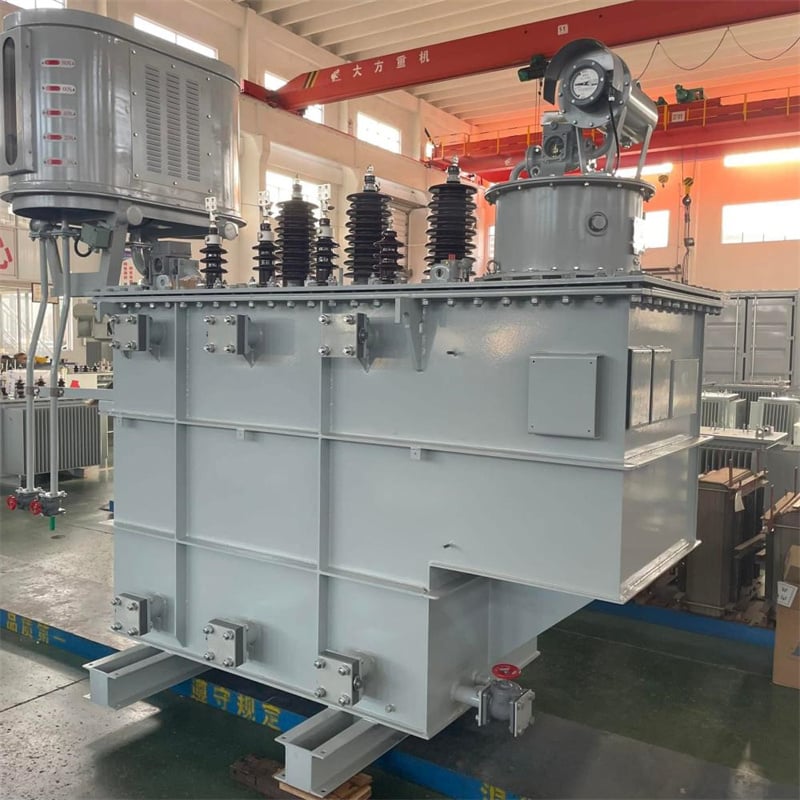
The traditional distribution model can be represented as:
Utility Grid → Distribution Transformer → Electrical Load
Solar PV and battery storage can change this relationship.
When a solar installation produces less power than the local load:
Utility Grid → Transformer → Load
When solar generation exceeds local consumption:
Solar PV → Transformer → Utility Grid
This condition is commonly described as reverse power flow or export power flow.
When a battery energy storage system is charging, power may flow:
Grid / Solar PV → Transformer → BESS
When the battery is discharging:
BESS → Transformer → Local Load / Grid
A hybrid project can combine all of these operating modes:
Utility Grid ↔ Distribution Transformer ↔ Solar PV / BESS / Commercial Load
This means the transformer may experience changing load levels and changing power-flow directions throughout the day.
The transformer itself is only one component of the system. In a complete renewable energy project, the transformer configuration should be coordinated with inverters, PCS equipment, switchgear, protection systems, grounding, metering, and the utility interconnection design.
Conventional electrical loads often follow relatively predictable patterns. Solar PV and BESS introduce more dynamic operating conditions.
Solar output varies with:
Solar irradiance
Cloud cover
Time of day
Season
System orientation
PV array capacity
Inverter control strategy
A transformer connected to a solar plant can therefore experience significant changes in loading over a single day.
A battery system may charge or discharge according to:
Time-of-use electricity prices
Peak shaving
Demand management
Renewable energy optimization
Grid services
Backup power requirements
Utility dispatch instructions
The transformer may therefore experience repeated changes between importing and exporting power.
Transformer selection should not be based only on average power.
Project teams should evaluate:
Maximum import power
Maximum export power
Continuous loading
Short-duration loading
Charging and discharging cycles
Daily operating profile
Seasonal operating profile
Future system expansion
The transformer must be evaluated under the actual operating scenarios expected throughout its service life.
Reverse power flow is not automatically a problem.
It becomes an engineering consideration when a distribution system was originally designed primarily for one-way power delivery and is later connected to significant distributed generation or storage.
Before selecting a bidirectional power flow transformer, project teams should evaluate the complete electrical system.
The local utility may define requirements for:
Maximum export capacity
Voltage regulation
Protection
Metering
Power quality
Transformer configuration
Grounding
Switching
Interconnection studies
These requirements should be confirmed before the transformer design is finalized.
The transformer turns ratio affects the voltage delivered to the downstream system.
When power flows in the opposite direction, voltage behavior can also change. The appropriate tap arrangement should therefore be evaluated based on the project's import and export operating conditions.
Reverse power flow can affect protection assumptions.
Engineers may need to review:
Directional protection
Overcurrent protection
Ground-fault protection
Recloser settings
Fuse coordination
Anti-islanding protection
Breaker ratings
The transformer cannot be considered separately from the overall protection system.
Maximum export current can affect:
Medium-voltage cables
Low-voltage conductors
Switchgear
Disconnects
Busbars
Metering equipment
All components should be checked against the maximum expected current in both directions.
Voltage management is another important consideration for solar and BESS projects.
When a PV system exports power into a distribution network, voltage can increase along the feeder, particularly when local demand is low and generation is high.
The magnitude of voltage rise depends on factors including:
Export power
Feeder impedance
Transformer impedance
Cable length
Local load
Network configuration
Inverter controls
A transformer alone cannot eliminate all voltage-rise issues.
When a BESS is charging at high power, it can create a significant local demand.
This may contribute to voltage drop depending on:
Charging power
Transformer capacity
Feeder impedance
Cable length
Existing load
Network strength
Depending on the project, engineers may evaluate:
Fixed tap settings
Off-circuit tap changers
On-load tap changers
Voltage regulators
Inverter voltage control
Reactive power control
The appropriate strategy depends on the utility network and project architecture.
Transformer selection should therefore be coordinated with inverter controls, voltage regulation equipment, and the overall interconnection study rather than treated as an isolated solution.
Solar inverters and battery energy storage systems use power electronics to convert electrical energy between AC and DC.
Other modern equipment—including PCS systems, UPS equipment, EV chargers, and variable-frequency drives—can also introduce nonlinear current characteristics.
Harmonic currents can contribute to:
Additional transformer heating
Increased losses
Reduced equipment efficiency
Voltage distortion
Increased thermal stress
The actual impact depends on the equipment design, harmonic spectrum, system impedance, operating conditions, and applicable standards.
Depending on the project, engineers may review:
Total harmonic distortion (THD)
Individual harmonic orders
Load current spectrum
Transformer thermal capability
Potential derating requirements
Inverter and PCS specifications
Power factor
Reactive power requirements
A transformer should not be selected based solely on its nominal kVA rating when a project contains substantial nonlinear loads.
The final design should be validated against the applicable electrical standards and project-specific power-quality requirements.
Both oil-filled distribution transformers and dry-type transformers can be used in renewable energy applications. The appropriate choice depends on the project.
| Project Factor | Oil-Filled Transformer | Dry-Type Transformer |
|---|---|---|
| Outdoor utility applications | Common option | Application dependent |
| Larger capacity projects | Often considered | Depends on design and site conditions |
| Indoor installation | Requires fluid/fire considerations | Often suitable for indoor applications |
| Fire-sensitive locations | Fluid selection and containment may need consideration | No insulating liquid |
| Environmental exposure | Configuration dependent | Configuration dependent |
| Maintenance | Depends on transformer design and fluid | Depends on ventilation and operating environment |
| Cooling | Liquid-assisted heat transfer | Air-based cooling |
| Final selection | Based on voltage, capacity, site, standards and total cost | Based on voltage, capacity, site, standards and total cost |
Oil-filled transformers are widely used in utility and outdoor distribution applications.
Depending on the project, insulating fluids can include conventional mineral oil or alternative fluids such as ester-based fluids.
Fluid selection should consider:
Fire requirements
Environmental conditions
Utility specifications
Installation location
Maintenance strategy
Environmental risk
Dry-type transformers eliminate liquid insulation and can be attractive for certain indoor, commercial, industrial, and fire-sensitive applications.
However, dry-type transformers also require appropriate ventilation, thermal management, installation space, and environmental protection.
There is no universal “best” transformer type for solar or BESS projects. The selection should follow the complete project design.
Related article: [Dry-Type vs. Oil-Filled Distribution Transformers]
Before requesting a quotation for a solar transformer or BESS transformer, project teams should establish the operating requirements.
What is the primary voltage?
What is the secondary voltage?
What is the rated transformer capacity?
What is the maximum import power?
What is the maximum export power?
What is the system frequency?
What impedance is required?
What vector group is required?
What tap configuration is required?
Is the transformer connected to solar PV only?
Is it connected to BESS only?
Is it part of a hybrid PV + BESS system?
Is the system grid-tied?
Can the microgrid operate in island mode?
Will the transformer experience bidirectional power flow?
What is the expected daily operating cycle?
Are significant nonlinear loads present?
What is the expected harmonic spectrum?
Is reactive power control required?
Is voltage regulation required?
Are there specific utility power-quality limits?
The project team should also consider:
Additional PV capacity
Additional BESS capacity
Higher export limits
New loads
EV charging
Microgrid expansion
Additional transformers
A transformer selected only for the initial installation may become a limitation if future expansion has not been considered.
Renewable energy projects can operate with significant changes in transformer loading throughout the day.
Monitoring can provide useful operating data for plant operators and maintenance teams.
Depending on transformer type and project requirements, monitoring may include:
Transformer load
Current
Voltage
Oil temperature
Winding temperature
Oil level
Cooling status
Alarm conditions
Overload events
Remote communication
For larger solar and BESS projects, transformer monitoring may be integrated with:
SCADA
Energy Management Systems (EMS)
Plant monitoring platforms
Building Management Systems
Remote asset management systems
This can help operators understand transformer operating conditions and identify abnormal events.
Monitoring does not eliminate equipment failures, but it can support condition-based maintenance and improve operational visibility.
This can be particularly useful for remote renewable energy sites where routine physical inspection may be less frequent.
A clear technical specification helps the transformer manufacturer understand the project's actual operating conditions.
| Requirement | Information to Provide |
|---|---|
| Site | Location and ambient conditions |
| Application | Solar / BESS / PV + BESS / Microgrid |
| Capacity | kVA or MVA |
| Primary voltage | HV / MV voltage |
| Secondary voltage | LV or MV voltage |
| Import power | Maximum grid-to-project power |
| Export power | Maximum project-to-grid power |
| Vector group | Project-specific requirement |
| Impedance | Required percentage |
| Tap configuration | Fixed / off-circuit / on-load |
| Cooling | Required cooling method |
| Transformer type | Dry-type / oil-filled |
| Fluid | Mineral oil / ester / other where applicable |
| Harmonics | Expected nonlinear load and power-quality requirements |
| Monitoring | Required sensors and communications |
| Standards | Applicable utility and electrical standards |
| Certifications | Required market/project certifications |
| Delivery | Required manufacturing and delivery schedule |
One of the most important additions to a renewable energy transformer RFQ is the maximum import and export power.
A conventional load-only specification may identify the maximum load but fail to describe how much energy the system can export.
For a bidirectional system, both directions should be included in the electrical study and equipment specification.
Microgrids introduce another layer of complexity because they may operate in both grid-connected and islanded modes.
A microgrid can combine:
Utility supply
Solar PV
BESS
Backup generators
Commercial or industrial loads
EV charging
Energy management systems
During grid-connected operation, the transformer may exchange power with the utility.
During islanded operation, the power-flow pattern can change significantly.
This means engineers may need to evaluate transformer behavior under multiple operating states rather than a single normal-load condition.
Key considerations can include:
Maximum import
Maximum export
Island-mode loading
Fault current
Grounding
Protection coordination
Voltage regulation
Frequency control
BESS inverter control
Generator interaction
The transformer specification should therefore be developed as part of the overall microgrid electrical design.
For renewable energy projects, the transformer manufacturer should be evaluated on more than standard product availability.
Project teams may want to review the manufacturer's:
Transformer engineering capabilities
Manufacturing capacity
Customization capabilities
Factory testing procedures
Quality management
Technical documentation
Delivery planning
Experience with renewable energy applications
Monitoring and accessory options
After-sales support
For customized projects, early engineering communication can help resolve voltage, impedance, vector group, cooling, monitoring, and enclosure requirements before manufacturing begins.
Dingxin Electric is a transformer and prefabricated substation manufacturer providing customized solutions for renewable energy, utility, industrial, commercial, and infrastructure projects.
Our product range includes:
Distribution transformers
Power transformers
Oil-immersed transformers
Dry-type transformers
Pad-mounted transformers
Prefabricated substations
Customized transformer solutions
For solar PV, BESS, and hybrid energy projects, Dingxin can support project-specific requirements involving capacity, voltage, impedance, vector group, tap configuration, cooling, monitoring, enclosure, and installation conditions.
Because renewable energy projects can operate with changing load profiles and bidirectional power flow, transformer selection should be based on the complete project operating model.
Dingxin can work with EPC contractors, developers, system integrators, utilities, and project owners to develop a transformer configuration based on the actual electrical requirements rather than relying solely on a standard catalog rating.
A solar distribution transformer is a transformer used to connect a solar PV generation system to a medium-voltage or other electrical distribution network. Its rating and configuration depend on the PV capacity, voltage levels, export requirements, interconnection design, and applicable standards.
A BESS transformer connects a battery energy storage system and its power conversion equipment to an electrical distribution or transmission system. Depending on the system configuration, the transformer may need to support both charging and discharging power flow.
A transformer can be designed and specified for systems with bidirectional power flow, but suitability should be evaluated as part of the complete electrical system. Protection, voltage regulation, thermal loading, impedance, grounding, and utility interconnection requirements all need to be considered.
Solar PV can cause reverse power flow when generation exceeds local electrical demand and excess power is exported toward the upstream distribution network. Whether this occurs depends on the system's load, PV capacity, energy storage, and export controls.
Yes. A BESS can increase transformer loading while charging and export power while discharging. The transformer should therefore be evaluated using the expected charging and discharging profile rather than only the average load.
Power electronic equipment such as solar inverters and BESS PCS can introduce harmonic currents. The actual harmonic performance depends on the equipment and system design, so engineers should evaluate the expected harmonic spectrum and applicable power-quality requirements.
Yes. Dingxin provides customized transformer and prefabricated substation solutions based on project-specific voltage, capacity, impedance, vector group, tap, cooling, monitoring, enclosure, and other requirements.
A renewable energy transformer should be designed around the project's maximum import power, maximum export power, load profile, voltage requirements, power quality, protection strategy, and future expansion plans.
Send Dingxin your single-line diagram, primary and secondary voltage, transformer capacity, maximum import/export power, operating profile, and utility interconnection requirements. Our engineering team can review the application and recommend a customized transformer configuration.
Request a Technical Quotation from Dingxin today for your solar, BESS, microgrid, or bidirectional power-flow project.
Dingxin Electric — Customized Transformer and Prefabricated Substation Solutions for Renewable Energy Projects.

Jiangsu Dingxin Electric, a high-tech power equipment manufacturer, produces high-quality transformers and substations, serving global markets across 30+ countries.
Room 118, Building 8, 2999 Hutai Road, Baoshan District, Shanghai, China

Copyright © Jiangsu Dingxin Electric Co., Ltd. All Rights Reserved | Privacy Policy
 EN
EN
