Tel: +86-513-88779999
Email: [email protected]
Tel: +86-513-88779999
Email: [email protected]
When selecting an energy-efficient distribution transformer, one of the most important design questions is the choice of core material. Amorphous-core transformers and CRGO transformers are both used in distribution applications, but their magnetic properties, loss characteristics, manufacturing requirements, and lifecycle economics can differ.
Amorphous-metal cores are generally associated with significantly lower no-load loss because of their low hysteresis and eddy-current losses. However, no-load loss should not be the only factor used to select a transformer. A proper comparison should also consider load loss, transformer loading, annual energization hours, electricity prices, purchase cost, physical requirements, noise, applicable efficiency standards, and expected service life.
For utilities and industrial users, the right question is therefore not simply “Amorphous core or CRGO?” It is:
Which transformer design provides the appropriate balance between efficiency, technical performance, initial cost, and total cost of ownership for the actual operating profile?
As a transformer and prefabricated substation manufacturer, Dingxin Electric can provide customized transformer configurations based on project-specific electrical, efficiency, installation, and operating requirements.
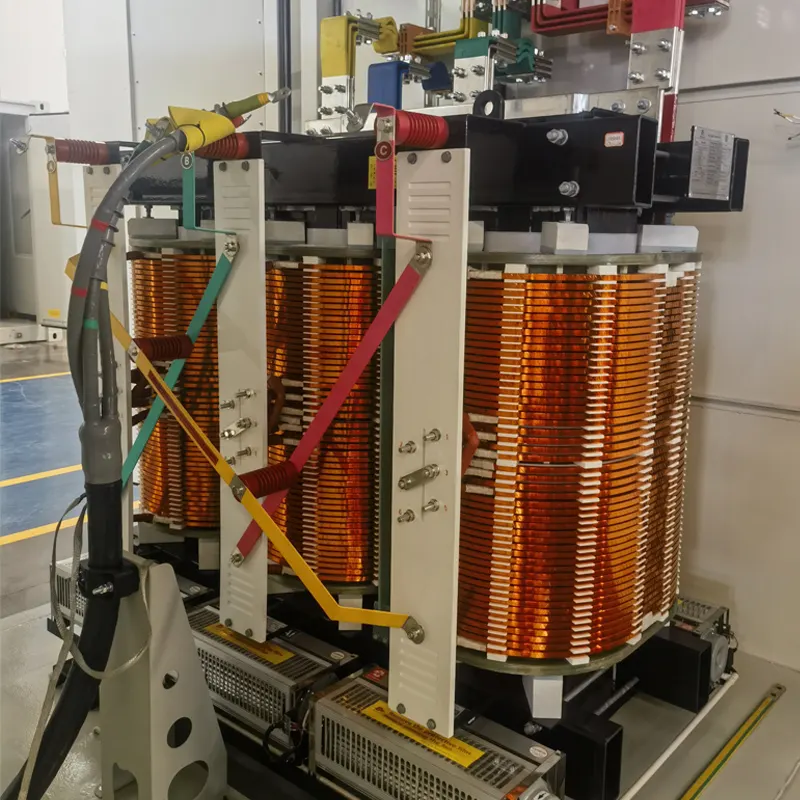
The magnetic core is one of the most important components of a distribution transformer.
Its primary function is to provide a low-reluctance path for the alternating magnetic flux generated by the primary winding. Because the transformer core is continuously magnetized and demagnetized when the transformer is energized, electrical energy is converted into heat through magnetic losses.
These losses are commonly divided into:
Hysteresis loss
Eddy-current loss
Together, they contribute significantly to what is commonly called no-load loss, core loss, or iron loss.
Importantly, no-load loss occurs even when the transformer has little or no secondary load.
This matters because distribution transformers can remain energized for thousands of hours every year. A transformer may therefore consume energy through core losses overnight, during weekends, or during periods when downstream demand is relatively low.
For large distribution networks with hundreds or thousands of transformers, even relatively small differences in individual no-load loss can accumulate into significant energy consumption over the operating life of the equipment.
No-load loss is the power consumed by a transformer when it is energized at its specified voltage and frequency while the secondary side is unloaded.
It is primarily associated with losses in the magnetic core.
A simplified calculation of annual no-load energy consumption is:
Where:
Eno-load = annual no-load energy loss
P₀ = measured or specified no-load loss
t = number of hours the transformer remains energized
For a transformer energized continuously throughout the year:
For example, if a transformer has a specified no-load loss of P₀, that loss continues as long as the transformer remains energized, regardless of whether the secondary load is high, low, or temporarily zero.
This is one reason why core material can have a meaningful effect on the lifecycle energy performance of a distribution transformer.
It is important not to confuse no-load loss with load loss.
No-load loss is primarily related to the core and remains relatively stable when voltage and frequency are stable.
Load loss changes with transformer loading and is primarily associated with winding resistance and other load-dependent effects.
Therefore, a transformer with very low no-load loss is not automatically the lowest-loss solution under every operating condition.
CRGO stands for Cold-Rolled Grain-Oriented electrical steel.
CRGO steel has been widely used in transformer manufacturing because its grain orientation provides favorable magnetic properties in the direction of the magnetic flux.
Modern CRGO transformer designs can achieve high efficiency when manufacturers optimize factors such as:
Electrical steel grade
Lamination thickness
Core geometry
Joint design
Magnetic flux density
Manufacturing tolerances
Core clamping
Winding configuration
Therefore, it would be inaccurate to assume that all CRGO transformers have high core losses.
The actual performance of a CRGO transformer depends on the selected material and the complete transformer design.
CRGO technology has a mature manufacturing ecosystem and extensive field experience. It can provide a practical balance between:
Efficiency
Cost
Size
Weight
Manufacturing flexibility
Material availability
Established production processes
For many utility, commercial, and industrial applications, a well-designed CRGO transformer can provide an appropriate combination of efficiency and overall project economics.
An amorphous-core transformer uses an amorphous-metal alloy as the magnetic core material.
Unlike conventional crystalline electrical steel, amorphous metal has a non-crystalline atomic structure. This material can exhibit very low magnetic hysteresis and eddy-current losses under suitable operating conditions.
As a result, amorphous-metal cores are generally capable of achieving substantially lower no-load losses than many conventional electrical-steel core designs.
This characteristic makes amorphous-core transformers particularly relevant for applications where transformers remain energized for long periods while operating at relatively low or variable load levels.
Depending on the specific design, application, and efficiency requirements, amorphous-core technology can offer:
Lower no-load loss
Reduced long-term core energy consumption
Potential lifecycle energy savings
Strong suitability for continuously energized distribution networks
Support for energy-efficiency and loss-reduction objectives
However, the material also has different mechanical and manufacturing characteristics from CRGO steel.
Depending on the transformer design, project requirements, and production process, factors such as dimensions, weight, noise, material handling, cost, and manufacturing complexity may need to be evaluated.
The following table provides a general comparison. Actual transformer performance should always be based on the manufacturer's guaranteed technical data rather than material type alone.
| Evaluation Factor | Amorphous-Core Transformer | CRGO-Core Transformer |
|---|---|---|
| No-load loss | Generally lower | Depends on steel grade and design |
| Load loss | Depends mainly on complete transformer design | Depends mainly on complete transformer design |
| Initial cost | May be higher depending on design and market | Mature cost and supply structure |
| Long-term energy-saving potential | Particularly relevant for continuously energized and lightly/moderately loaded applications | Can provide high efficiency with optimized design |
| Material characteristics | Non-crystalline magnetic alloy | Grain-oriented electrical steel |
| Manufacturing | Requires specific core processing and handling | Mature and widely established |
| Size and weight | Application and design dependent | Application and design dependent |
| Noise | Must be evaluated from the complete design | Must be evaluated from the complete design |
| Main selection focus | Minimizing core loss and lifecycle energy consumption | Balancing cost, efficiency, availability, and performance |
The table should not be interpreted as a universal ranking. Transformer performance depends on the actual core material grade, magnetic flux density, winding design, cooling system, rated capacity, voltage, manufacturing process, and applicable standards.
This is one of the most important principles when comparing an amorphous core transformer with a CRGO transformer.
A buyer should not select a transformer simply because one quotation shows a lower no-load loss.
A more complete technical and commercial comparison should include:
How much power does the transformer consume when energized without secondary load?
How much energy is lost when the transformer operates under its expected load profile?
Does the transformer operate at 20%, 40%, 60%, or 80% loading for most of the year?
How many hours per year will the transformer remain energized?
A lower-loss transformer becomes more economically attractive when the avoided energy cost is sufficiently high.
The initial price difference between two transformer technologies must be included in the lifecycle calculation.
A transformer expected to remain in operation for several decades may justify a different economic analysis from temporary or short-duration equipment.
Weight, dimensions, noise, installation space, transportation, and foundation requirements can influence the total project cost.
The applicable local or national energy-efficiency requirements should be confirmed before final equipment selection.
Utilities may have specific requirements for transformer losses, materials, testing, accessories, and documentation.
The best comparison is therefore based on actual guaranteed loss data and the project's operating profile, not a generic technology label.
A basic energy-loss calculation can help compare different transformer designs.
A simplified annual loss-cost model is:
Where:
P₀ = no-load loss
8,760 = hours in one year for continuous energization
Pₖ = load loss at the specified reference load
Hequivalent = equivalent full-load hours derived from the actual load profile
Energy Price = applicable electricity cost
This is a simplified engineering-economic model.
A complete transformer total cost of ownership (TCO) analysis may also include:
Initial purchase price
Transportation
Installation
Energy losses
Maintenance
Inspection
Expected service life
Replacement cost
Financing or discount rate
Electricity price escalation
Demand charges where applicable
Carbon-related costs where applicable
Consider two transformers with different no-load and load losses.
If Transformer A has substantially lower no-load loss but higher load loss, while Transformer B has somewhat higher no-load loss but lower load loss, the better lifecycle option can depend on how the transformer is actually operated.
For a lightly loaded transformer that remains energized continuously, no-load loss may have a particularly significant effect.
For a heavily loaded transformer operating for long periods, load loss becomes increasingly important.
This is why a project-specific loss analysis is more useful than a simple comparison of core materials.
Amorphous-core technology may be particularly worth evaluating in applications with a strong focus on reducing no-load losses.
Potential applications include:
Distribution transformers in utility networks can remain energized continuously, even when downstream demand varies significantly.
Large numbers of transformers operating across a network can make aggregate core losses an important consideration.
Where transformers frequently operate below their rated capacity but remain energized, lower no-load losses may provide a meaningful lifecycle advantage.
Where electricity prices are relatively high, reducing long-term transformer losses can have a greater economic impact.
Projects with specific energy-efficiency, carbon-reduction, or technical-loss targets may evaluate amorphous-core designs as part of their transformer strategy.
For utilities or developers purchasing hundreds or thousands of similar transformers, even a small per-unit reduction in annual energy losses can become significant at the network level.
However, these applications should still be evaluated using actual technical data, project load profiles, and lifecycle economics.
CRGO remains an established technology for a wide range of distribution transformer applications.
A CRGO-based design may be appropriate where the project places significant emphasis on:
Balanced initial and lifecycle cost
Established manufacturing processes
Material availability
Specific size or weight requirements
High-load operation
Existing utility specifications
Familiar maintenance practices
Established product standards
A well-engineered CRGO transformer can achieve strong efficiency performance.
The important point is that CRGO should not be treated as synonymous with inefficient transformer design.
Modern electrical steel grades, optimized core geometry, controlled magnetic flux density, improved joint construction, and optimized winding design can all influence the final loss performance.
The same transformer technology can have very different economics in different applications.
A transformer serving a lightly loaded distribution network may remain energized 24/7.
In this situation, no-load loss can represent a significant portion of total annual energy loss.
A lower-loss core design may therefore deserve closer evaluation.
A transformer supplying a heavily loaded industrial facility may spend much of its operating time at relatively high load.
In this case, load losses become increasingly important, and the complete transformer design should be evaluated.
A commercial building may have substantial differences between daytime, nighttime, weekdays, and weekends.
The economic comparison should therefore use the expected annual load curve rather than a single assumed loading percentage.
Solar PV and BESS systems can create changing and potentially bidirectional power flows.
In such applications, the transformer should be evaluated for the actual operating conditions, including loading direction, voltage variation, harmonics, and protection requirements.
Before purchasing a low-loss or energy-efficient distribution transformer, ask the manufacturer for specific technical information.
What are the guaranteed no-load losses?
What are the guaranteed load losses?
At what reference temperature are losses specified?
At what voltage and frequency are no-load losses measured?
Which efficiency requirements does the transformer meet?
Which standards are used for loss measurement?
Are efficiency or loss values guaranteed in the purchase specification?
Are no-load and load losses tested during factory testing?
Can the manufacturer provide test reports?
What factory acceptance testing is included?
What core material and grade are used?
What winding material is used?
How does the design control magnetic flux density?
What is the expected noise level?
What are the dimensions and weight?
What is the expected manufacturing lead time?
Can the manufacturer provide a lifecycle-cost comparison?
Can the transformer be customized for the project?
Are spare parts and technical support available?
The answers should be documented in the technical specification and quotation rather than relying only on general product descriptions.
The selection process can be summarized in five steps.
Determine expected loading throughout the year rather than using only the maximum connected load.
Request both no-load loss and load loss from each supplier.
Use the expected energization hours and load profile to estimate annual losses.
Combine purchase price, energy costs, maintenance, expected service life, and other relevant project costs.
Make sure the selected transformer meets utility specifications, applicable efficiency standards, installation requirements, and project-specific technical requirements.
This process gives project owners a more defensible basis for selecting between amorphous-core and CRGO transformer designs.
Dingxin Electric is a transformer and prefabricated substation manufacturer providing customized transformer solutions for utility, commercial, industrial, renewable energy, and infrastructure applications.
Our transformer portfolio includes:
Distribution transformers
Power transformers
Oil-immersed transformers
Dry-type transformers
Pad-mounted transformers
Prefabricated substations
Customized transformer solutions
For projects where transformer losses are an important part of the purchasing decision, Dingxin can work with customers to evaluate the required capacity, voltage, core technology, winding configuration, cooling method, efficiency targets, installation conditions, and applicable standards.
The appropriate core technology depends on the project rather than on a universal preference for one material. By considering guaranteed loss data together with the actual load profile and lifecycle economics, project owners can make a more informed transformer selection.
Amorphous-core transformers generally have lower no-load losses than many conventional CRGO designs. However, overall transformer efficiency also depends on load loss, loading conditions, design, and operating profile.
The primary advantage is its potential for significantly reduced no-load or core losses. This can be particularly valuable for transformers that remain energized for long periods and operate at relatively low or variable loads.
CRGO means Cold-Rolled Grain-Oriented electrical steel. It is a widely used magnetic core material for transformers and can provide high efficiency when properly selected and designed.
No-load loss primarily occurs in the transformer core when the equipment is energized. Load loss increases as electrical current flows through the transformer windings and is strongly related to transformer loading.
That depends on the project's operating profile, electricity price, annual energization hours, transformer loading, service life, and price difference between technologies. A total cost of ownership analysis should be performed rather than evaluating purchase price alone.
Dingxin provides customized transformer solutions based on project-specific requirements. The applicable core technology, capacity, voltage, efficiency target, cooling method, winding configuration, and other parameters can be evaluated according to the application.
Choosing between an amorphous core transformer and a CRGO transformer should be based on measurable performance and lifecycle economics—not simply the lowest purchase price or a single loss figure.
Planning a new distribution transformer project? Contact Dingxin's engineering team for a project-specific evaluation of transformer capacity, voltage, no-load loss, load loss, core options, efficiency requirements, and total cost of ownership.
Send us your voltage, kVA rating, expected load profile, annual operating hours, and energy-cost assumptions, and our engineering team can help define a customized transformer solution for your application.
Dingxin Electric — Customized Transformer and Prefabricated Substation Solutions.

Jiangsu Dingxin Electric, a high-tech power equipment manufacturer, produces high-quality transformers and substations, serving global markets across 30+ countries.
Room 118, Building 8, 2999 Hutai Road, Baoshan District, Shanghai, China

Copyright © Jiangsu Dingxin Electric Co., Ltd. All Rights Reserved | Privacy Policy
 EN
EN
