 EN
EN
Transformers help electrical systems deliver power at the voltage required by equipment and distribution networks. Two common types are step-up transformers and step-down transformers.
The main difference is simple: a step-up transformer increases voltage, while a step-down transformer decreases it. Choosing the right type helps match the power supply to the application and supports safe, reliable operation.
As a transformer manufacturer, Dingxin explains how these transformers work, where they are used, and what to consider when selecting one.
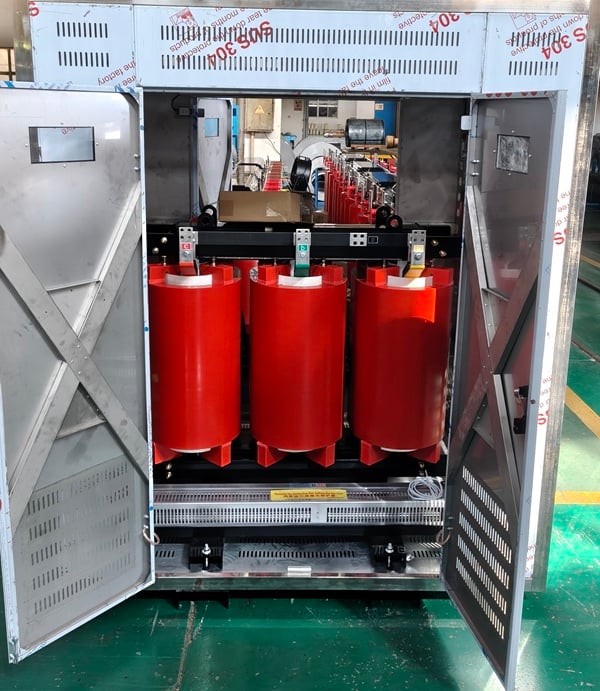
How Does a Transformer Work?
A transformer transfers electrical energy between windings through electromagnetic induction. In a conventional transformer, alternating current in the primary winding creates a changing magnetic field in the core, inducing voltage in the secondary winding.
The voltage change depends mainly on the ratio of turns in the two windings:
Secondary voltage ÷ Primary voltage ≈ Secondary turns ÷ Primary turns
If the secondary winding has more turns than the primary winding, the transformer increases voltage. If it has fewer turns, the transformer decreases voltage.
A transformer changes voltage and current levels; it does not generate additional power or change the supply frequency. Output power is slightly lower than input power because of losses in the windings, core, and other components.
What Is a Step-Up Transformer?
A step-up transformer raises the voltage from its input to its output. Its secondary winding generally has more turns than its primary winding.
For example, a step-up transformer may increase a generator’s output voltage to a higher level suitable for connection to a transmission or distribution network.
For approximately the same transferred power, increasing voltage reduces current. Lower current reduces resistive losses in conductors, which is one reason higher voltages are used to transmit electricity over long distances.
Common applications include:
- Power generation: Raising generator output voltage for grid connection.
- Renewable energy systems: Increasing voltage from solar inverter or wind generation systems to the required collection or grid voltage.
- Industrial equipment: Supplying equipment that requires a higher voltage than the available source.
- Testing systems: Providing elevated voltages for specialized electrical testing.
What Is a Step-Down Transformer?
A step-down transformer reduces the voltage from its input to its output. Its secondary winding generally has fewer turns than its primary winding.
For example, a distribution transformer may reduce a medium-voltage supply to the low-voltage level needed by a factory, commercial building, or residential network.
At its rated capacity, the lower-voltage side carries a higher current than the higher-voltage side. Conductors, terminals, and protective devices must therefore be selected for the appropriate current levels.
Common applications include:
- Power distribution: Converting medium voltage to usable low voltage.
- Industrial facilities: Matching incoming power to machinery and production equipment.
- Commercial buildings: Supplying lighting, HVAC systems, and other electrical loads.
- Control circuits: Providing lower AC voltages for compatible control equipment.
Step-Up vs. Step-Down Transformers at a Glance
| Feature | Step-Up Transformer | Step-Down Transformer |
|---|---|---|
| Main function | Increases voltage | Decreases voltage |
| Secondary turns | More than the primary | Fewer than the primary |
| Secondary current at comparable power | Lower than the primary current | Higher than the primary current |
| Typical role | Raising voltage for transmission or equipment | Reducing voltage for distribution or equipment |
| Common installation | Generation and grid connection systems | Distribution networks and end-user facilities |
Neither type is inherently more efficient or more reliable. Performance depends on the transformer’s design, materials, loading, cooling, and operating conditions.
Can a Step-Down Transformer Be Used in Reverse?
Some transformers can operate in reverse, but reverse connection should not be assumed suitable without manufacturer confirmation.
Tap arrangements, voltage compensation, insulation requirements, grounding, winding connections, and inrush current can affect the result. A transformer designed for one application may not deliver the required performance or meet installation requirements when connected in reverse.
For a new project, selecting a transformer designed for the intended operating direction is usually the simplest approach.
How to Choose the Right Transformer
Start by confirming whether your application needs a voltage increase or decrease. Then check the following specifications:
- Input and output voltage: Include the expected supply variation and any required tap adjustment.
- Rated capacity: Specify the required kVA or MVA, considering load demand, motor starting, and planned expansion.
- Phase and frequency: Match the transformer to the electrical system.
- Load characteristics: Identify motors, inverters, rectifiers, or other loads that may affect transformer sizing and design.
- Installation conditions: Consider indoor or outdoor use, ambient temperature, altitude, ventilation, and enclosure requirements.
- System requirements: Confirm winding connections, grounding, impedance, insulation levels, and applicable standards.
Voltage ratio alone is not enough to select a transformer. The complete electrical and environmental requirements determine whether it is suitable for the project.
Discuss Your Transformer Requirements with Dingxin
Step-up and step-down transformers serve different voltage-conversion needs, but both are essential to effective power systems.
As a transformer manufacturer, Dingxin welcomes inquiries for your next project. Share your input voltage, required output voltage, rated capacity, frequency, and installation conditions with our team to discuss a suitable transformer solution.