Tel: +86-513-88779999
Email: [email protected]
Tel: +86-513-88779999
Email: [email protected]
Transformer impedance is an important electrical parameter that affects voltage regulation, short-circuit current, and the operating performance of a power distribution system. When selecting a distribution transformer, engineers and project buyers should consider impedance together with rated capacity, voltage ratio, load characteristics, and protection requirements.
Understanding transformer impedance helps utilities, industrial facilities, and EPC contractors select suitable equipment and coordinate downstream electrical systems.
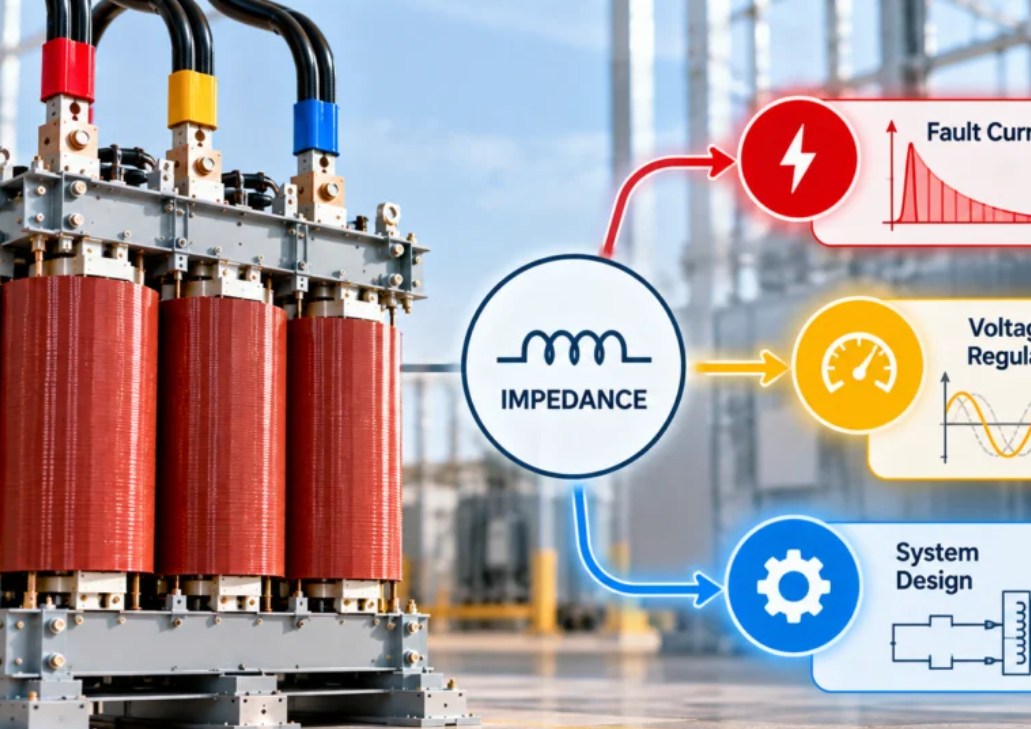
Transformer impedance is the combined effect of resistance and leakage reactance in a transformer. It represents the opposition to alternating current within the transformer windings and is commonly expressed as a percentage of rated voltage.
The percentage impedance, usually written as %Z, is one of the key parameters shown on a transformer nameplate or technical datasheet.
For example, a transformer with 4% impedance requires approximately 4% of its rated voltage to circulate rated current when the secondary winding is short-circuited under the specified test conditions.
In practical transformer engineering, impedance is important because it influences how the transformer responds to load changes and electrical faults.
Percentage impedance expresses the transformer impedance relative to its rated voltage.
A simplified relationship is:
Percentage Impedance (%Z) = (Impedance Voltage / Rated Voltage) × 100%
The impedance voltage is determined during the transformer short-circuit impedance test. The test is normally performed with one winding short-circuited and a reduced voltage applied to the other winding until rated current flows, according to the applicable test procedure.
A lower percentage impedance generally allows a higher short-circuit current to flow for the same transformer rating and system conditions. A higher percentage impedance generally limits the available short-circuit current.
The actual fault current also depends on the upstream network impedance, cable impedance, and other connected equipment.
Transformer impedance contributes to the voltage drop between the primary and secondary sides when the transformer supplies a load.
As the load current increases, voltage drop across the transformer impedance becomes more significant. The magnitude of the voltage variation also depends on the load power factor.
For many distribution applications, engineers need to evaluate voltage regulation at expected operating loads rather than considering only the no-load secondary voltage.
A transformer with unsuitable impedance may contribute to excessive voltage variation, especially in systems with high load demand or long downstream feeders.
Transformer impedance is directly related to the short-circuit current available at the transformer terminals.
For an idealized transformer supplied by an infinite-capacity source, the approximate symmetrical short-circuit current at rated voltage can be estimated as:
Short-Circuit Current ≈ Rated Current × (100 / %Z)
For example, if transformer impedance is 4%, the idealized short-circuit current is approximately 25 times the rated current.
This is a simplified estimate. Actual fault current must account for upstream source impedance, cables, connections, and the complete system configuration.
This relationship is important when selecting circuit breakers, fuses, busbars, and other protective equipment.
The available fault current affects the interrupting capacity required for downstream switchgear.
If transformer impedance is lower than expected, the fault current may be higher than the protection system was designed to withstand.
If impedance is higher, the fault current may be reduced, which can also influence the sensitivity and coordination of protective devices.
Therefore, transformer impedance should be confirmed during the electrical system design stage.
When two or more transformers operate in parallel, their impedance values and impedance characteristics influence load sharing.
For satisfactory parallel operation, engineers should check:
Compatible voltage ratios and tap positions
Matching or compatible vector groups
Similar percentage impedance
Compatible impedance angles or X/R ratios
Appropriate rated capacities and operating conditions
If transformers have significantly different impedances, they may not share the load evenly. One transformer could become overloaded while another operates below its available capacity.
Parallel operation should always be reviewed against the manufacturers' data and the project electrical design.
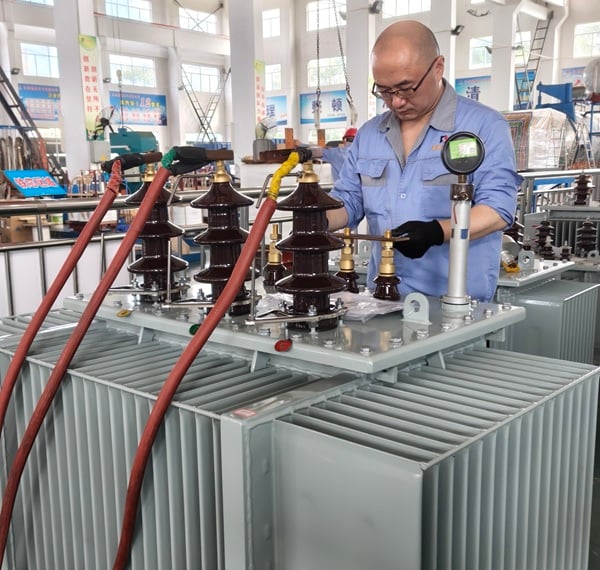
Neither high nor low transformer impedance is automatically better. The correct value depends on the power system.
| Factor | Higher Impedance | Lower Impedance |
|---|---|---|
| Short-circuit current | Generally lower | Generally higher |
| Voltage drop | May be higher | May be lower |
| Switchgear fault duty | May reduce fault duty | May increase fault duty |
| Parallel operation | Must be coordinated | Must be coordinated |
| Application suitability | Depends on system design | Depends on system design |
Engineers must balance voltage regulation, fault-current limitation, equipment ratings, and operating requirements.
Before specifying transformer impedance, project engineers should review the following information:
Rated capacity: Transformer capacity affects rated current and the system's available fault level.
Primary and secondary voltage: The voltage ratio must match the distribution network.
Short-circuit level: The upstream network fault level is important for calculating the actual fault current.
Protection equipment: Circuit breakers, fuses, and switchgear must have suitable ratings.
Parallel operation: If transformers will operate in parallel, impedance compatibility must be considered.
Applicable standards: The transformer should be designed and tested according to the project requirements and applicable standards, such as the relevant parts of IEC 60076 or IEEE C57 series.
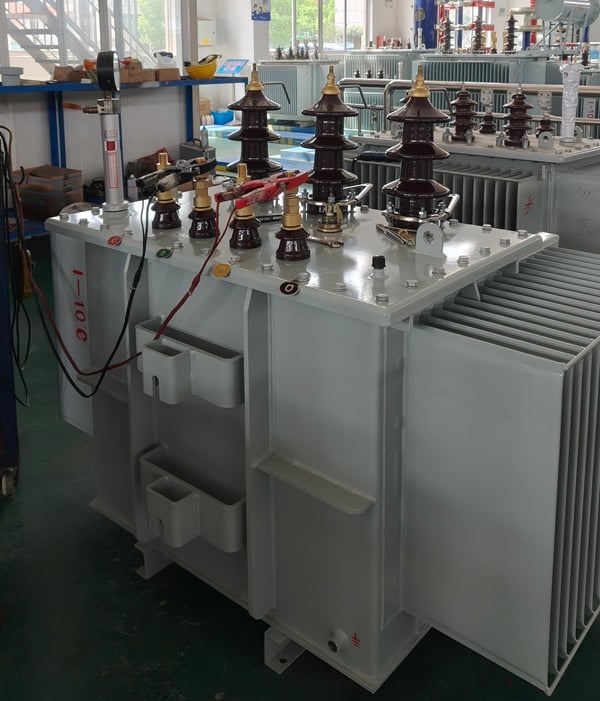
Dingxin's published S13-M fully sealed oil-immersed distribution transformer range covers 30 kVA to 2500 kVA.
The published product specifications list:
Rated capacity: 30–2500 kVA
High voltage: 6 kV, 6.3 kV, 10 kV, or 10.5 kV
Low voltage: 0.4 kV
Short-circuit impedance: 4.0% for ratings up to 630 kVA; 4.5% for ratings from 800 kVA and above
Cooling: ONAN, oil-immersed self-cooling
Tank: Fully sealed corrugated oil tank
These are the published specifications for the listed S13-M configurations. Buyers should confirm the exact rating, voltage combination, connection group, and impedance in the final technical datasheet and approved drawings.
For projects requiring a specific impedance value, provide the system short-circuit level and technical specification to the manufacturer before ordering.
Transformer impedance is the combined resistance and leakage reactance of a transformer, commonly expressed as a percentage of rated voltage.
Generally, yes. Higher transformer impedance limits the short-circuit current contributed by the transformer, assuming other system conditions remain unchanged.
Yes. Transformer impedance contributes to voltage drop under load. The actual voltage variation depends on current, impedance, and load power factor.
They may be technically possible to operate in parallel only after a detailed engineering assessment. Different impedance values can cause unequal load sharing. Voltage ratio, vector group, impedance angle, and other conditions must also be checked.
Some transformer designs can be specified with project-specific impedance requirements. Feasibility depends on transformer rating, design, and applicable standards. Buyers should state the required impedance in the RFQ.
Choosing the right transformer impedance is essential for voltage performance, short-circuit protection, and reliable power distribution.
Jiangsu Dingxin Electric provides oil-immersed and dry-type transformer solutions for utility, industrial, infrastructure, and renewable energy applications.
If you are planning a distribution transformer project, send Dingxin your rated capacity, primary and secondary voltage, required impedance, system short-circuit level, and applicable standards.
Contact Dingxin Electric to discuss your transformer specifications and request a project quotation.

Jiangsu Dingxin Electric, a high-tech power equipment manufacturer, produces high-quality transformers and substations, serving global markets across 30+ countries.
Room 118, Building 8, 2999 Hutai Road, Baoshan District, Shanghai, China


Copyright © Jiangsu Dingxin Electric Co., Ltd. All Rights Reserved | Privacy Policy
 EN
